
For any business operating in the Greater Sydney area, electrical safety is not just a best practice. It is a strict legal mandate. In 2026, the landscape of electrical compliance in New South Wales has shifted. With the full implementation of the BCNSW eCert portal and updated Work Health and Safety (WHS) Regulations 2025, the stakes for maintaining a safe workplace have never been higher.
An electrical audit is a formal, systematic examination of your commercial property’s electrical infrastructure. It ensures that your wiring, switchboards, and appliances comply with the AS/NZS 3000 Wiring Rules and the WHS Act 2011.
Whether you are a retail shop in the CBD, a warehouse in Western Sydney, or a strata manager in North Sydney, this guide will walk you through exactly how to prepare for an audit to avoid hefty fines, insurance complications, and, most importantly, workplace accidents.
1. Understand the Regulatory Environment in 2026
Before you begin your physical preparations, you must understand what Sydney inspectors are looking for this year.
The BCNSW eCert Mandate
As of July 1, 2026, all Certificates of Compliance for Electrical Work (CCEW) in NSW must be submitted via the digital BCNSW eCert portal. Paper forms and PDFs are no longer accepted. During an electrical audit, an inspector will verify that any major work or alterations performed on your premises since late 2025 have been logged digitally. If you cannot produce these digital records, your business may be flagged for non-compliance.
WHS Regulation 2025 Updates
The latest WHS updates place a duty of care on the Person Conducting a Business or Undertaking (PCBU) to manage electrical risks. This includes ensuring that all at-risk equipment is regularly inspected and tested. Failing to provide documented evidence of these checks can lead to on-the-spot fines of up to $1,000 or corporate penalties reaching $550,000 for severe neglect.
2. Conduct a Preliminary Walk-Through Inspection
You don’t need to be an electrician to spot obvious red flags. Before your formal electrical audit begins, perform a site walk-through to identify obvious issues that could cause a fail before the inspector even steps inside.
Check for Physical Damage
- Power Points & Switches: Look for cracked faceplates, discolouration (scorching), or loose fittings.
- Exposed Wiring: Ensure no cables are visible through walls or ceilings, especially in storage areas or back-of-house zones.
- Flexible Cords: Inspect extension leads and appliance cords for fraying or exposed copper.
Identify Overloaded Circuits
- Power Boards: Are you “daisy-chaining” power boards (plugging one into another)? This is a major fire hazard and an automatic fail in a Sydney electrical audit.
- High-Load Appliances: Ensure kettles, heaters, and printers aren’t all crowded onto a single circuit.
3. Review Your Switchboard and Circuit Protection
The switchboard is the heart of your business’s safety. In 2026, inspectors are particularly focused on Residual Current Devices (RCDs).
RCD Compliance
Under current Australian standards, RCDs (safety switches) are mandatory for all final sub-circuits in residential settings and are increasingly required for non-domestic installations where hand-held equipment is used.
- The Push-Button Test: You should be testing your RCDs every six months using the built-in test button.
- Professional Testing: During a formal electrical audit, an electrician will use specialised equipment to ensure the RCD trips within the required milliseconds (usually less than 300ms).
Switchboard Labelling
Is your switchboard a mess of handwritten scribbles from 1995? An auditor requires clear, legible, and accurate labelling of every circuit. If an emergency occurs, your staff must know exactly which switch kills the power to a specific area.
4. Documentation: The Auditor’s Best Friend
In the world of compliance, “if it isn’t documented, it didn’t happen.” To pass your electrical audit, you must have an organised compliance file (either physical or digital) containing:
- Test and Tag Logs: Records of all portable appliance testing conducted under AS/NZS 3760.
- CCEW Records: Digital copies of compliance certificates from the BCNSW eCert portal.
- Maintenance Schedules: Proof of regular electrical maintenance, such as emergency lighting tests and thermal imaging reports.
- Risk Assessments: A documented process showing how you identify and mitigate electrical hazards in your specific workplace.
5. Prepare Your Essential Safety Measures (ESM)
If your business is located in a commercial building in Sydney, you are likely required to submit an Annual Fire Safety Statement (AFSS). Electrical systems play a critical role in fire safety.
Exit and Emergency Lighting
During an electrical audit, the technician will perform a discharge test on your emergency lighting. These lights must remain illuminated for 90 minutes on battery power to allow for a safe evacuation during a blackout.
- Monthly Visual Checks: Ensure all Exit signs are lit.
- 6-Monthly Professional Tests: Mandatory under AS 2293.2.
Smoke Alarms and Detection
Ensure your smoke alarms are not expired (they generally have a 10-year lifespan) and that they are interconnected if required by your building classification.
6. Specialist Testing: Thermal Imaging
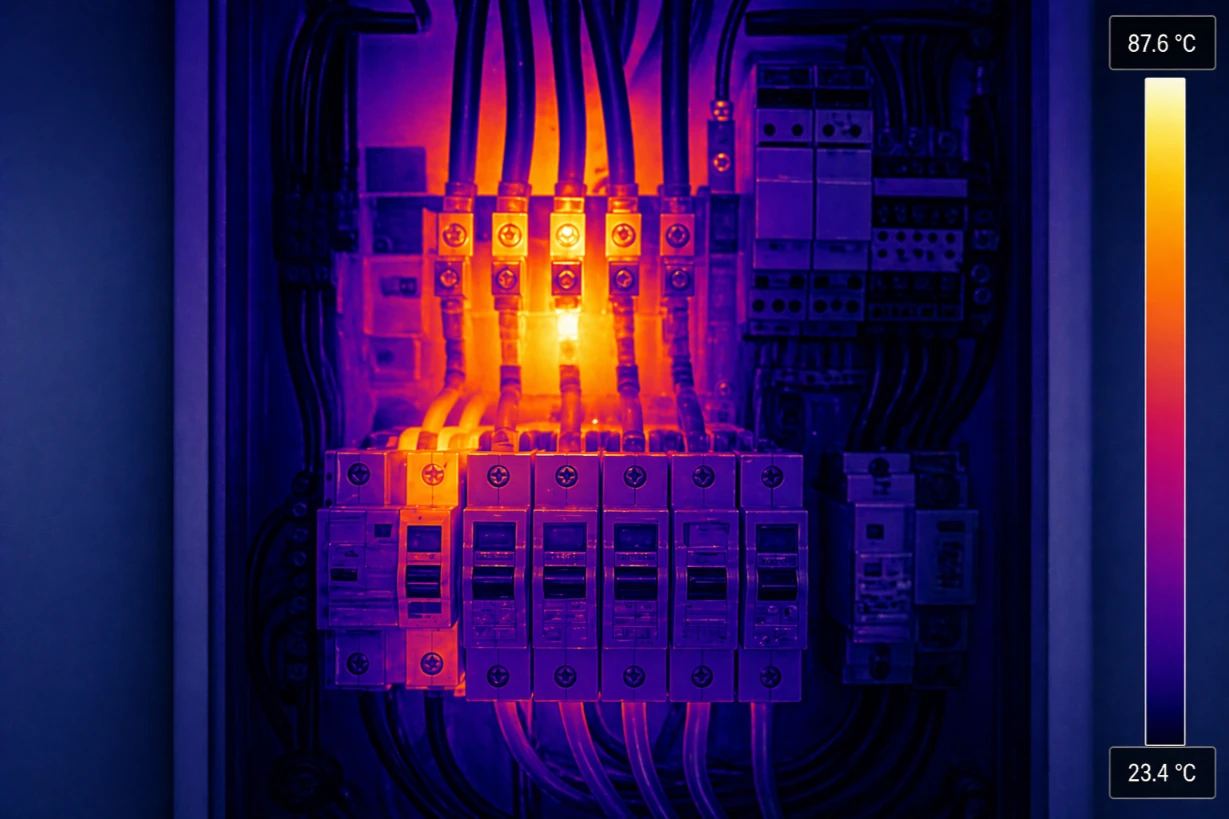
One of the most effective ways to prepare for a high-level electrical audit is to request a thermal imaging (thermographic) scan of your switchboard.
Electrical faults often generate heat before they cause a fire or a circuit failure. An infrared camera detects hot spots caused by loose connections or overloaded breakers that are invisible to the naked eye. Proactively fixing these hot spots ensures you pass your audit with flying colours and prevents costly downtime.
7. The 2026 Sydney Checklist for Electrical Audits
Use this checklist to ensure your business is ready for the inspector:
Category | Action Item | Status (Done/Pending) |
Documentation | Access to BCNSW eCert portal for recent work. | [ ] |
Safety Switches | All RCDs tested and functioning. | [ ] |
Test & Tag | All portable equipment tagged and within date. | [ ] |
Emergency Lights | 90-minute discharge test completed recently. | [ ] |
Access | Clear 600mm space in front of all switchboards. | [ ] |
Labelling | All circuits clearly identified and matched to loads. | [ ] |


