
If you have ever peered into your switchboard after a power failure, you have likely seen a row of switches. Some might be labelled “Main Switch,” while others have “Safety” or “RCD” printed on them. For the average person, it is easy to assume they all do the same thing: turn off the power when something goes wrong.
However, understanding the debate of Safety Switch vs Circuit Breaker is vital for your home’s safety. One is designed to protect your appliances and wiring from catching fire, while the other is designed to save your life from a fatal electric shock.
In this comprehensive safety switch vs circuit breaker guide, we will break down the mechanics, the legal requirements in Australia, and why having both is non-negotiable for modern electrical safety.
1. What is a Circuit Breaker?
A circuit breaker is essentially a sophisticated, resettable fuse. Its primary job is to protect the electrical wiring and the appliances in your home from damage caused by excessive current.
How it Works
A circuit breaker monitors the amount of current (Amps) flowing through a circuit. Every circuit in your home, whether it is for your oven, your air conditioner, or your bedroom lights, has a maximum capacity. If you plug in too many appliances at once, or if there is a “short circuit,” the current surges.
The circuit breaker detects this “overload” and snaps into the ‘Off’ position. This prevents the copper wires inside your walls from overheating, melting their insulation, and potentially starting a house fire.
Key Features:
- Protection Focus: Wiring and hardware.
- Trigger: Overcurrent and short circuits.
- Analogy: It is like a pressure valve on a water pipe; if the pressure gets too high, it shuts off to stop the pipe from bursting.
2. What is a Safety Switch (RCD)?
A safety switch, technically known in Australia as a Residual Current Device (RCD), is a life-saving device. While the circuit breaker cares about the wires, the safety switch cares about you.
How it Works
The key difference between an RCD and a circuit breaker comes down to balance. An RCD constantly monitors the balance of electricity flowing through the “active” and “neutral” wires. In a perfectly safe circuit, the amount of electricity going into an appliance should exactly match the amount coming back out.
If an RCD detects a current leak as small as 30 milliamperes, it assumes that electricity is escaping to earth, potentially through a human body. It can shut off the power in as little as 0.03 seconds. This is fast enough to prevent a fatal electric shock.
Key Features:
- Protection Focus: Human life and preventing electrocution.
- Trigger: Current leakage (residual current).
- Identification: Most safety switches have a “T” or “Test” button on the front.
3. Safety Switch vs Circuit Breaker: The Main Differences
To help clarify the safety switch vs circuit breaker comparison, let’s look at the specific scenarios they handle:
| Feature | Circuit Breaker | Safety Switch (RCD) |
| Main Goal | Prevent fire/wire damage. | Prevent electrocution. |
| Detects | Too much power (Amps). | Power leaking to earth. |
| Reaction Time | Fast (seconds). | Instant (milliseconds). |
| Mandatory? | Yes, for all circuits. | Yes, for all new/modified circuits. |
| Test Button? | No. | Yes. |
The “Short Circuit” Scenario
If a rat chews through a cable and the active and neutral wires touch, a massive surge of power occurs. The circuit breaker will trip to stop a fire.
The “Frayed Toaster Cord” Scenario
If you touch a frayed cord while the toaster is on, electricity will flow through your body to the ground. This might not be enough “Amps” to trip a circuit breaker, but the safety switch will detect that the electricity isn’t returning through the neutral wire and will cut the power instantly, saving your life.
4. Safety Switch vs Fuse: An Ancient Rivalry
If your home was built before the 1980s, you might still have ceramic fuses. In the hierarchy of safety switch vs fuse, the fuse is the grandfather of the circuit breaker.
Fuses work by having a small piece of wire that literally melts when too much power flows through it. While effective at preventing fires, they are incredibly dangerous because:
- They are slow to react.
- People often replace them with the wrong thickness of wire, which can lead to fires.
- They provide zero protection against electrocution.
If you still have a fuse box, a switchboard upgrade to modern RCDs and circuit breakers is the single best investment you can make for your family’s safety.
5. What is an RCBO? The Modern Solution
In modern Australian electrical maintenance, we often use a device called an RCBO (Residual Current Breaker with Overcurrent protection).
As the name suggests, an RCBO combines the protection of an RCD and a circuit breaker into a single unit. This is the gold standard because it provides dedicated protection for every individual circuit. If your toaster trips the safety switch in the kitchen, your lights and fridge will stay on because each circuit has its own combined protection.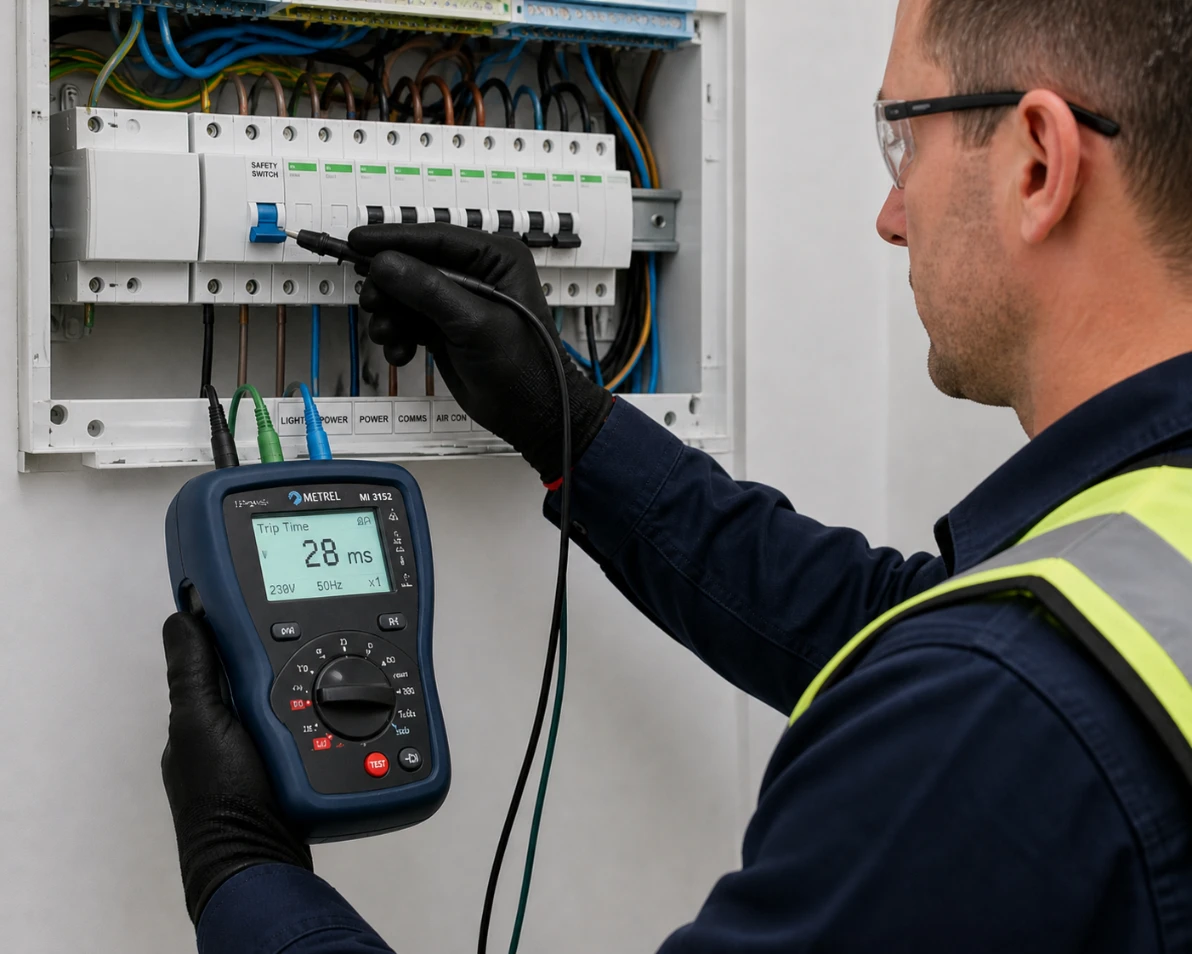
6. Australian Legal Requirements (AS/NZS 3000)
In Australia, the “Wiring Rules” (AS/NZS 3000) are very strict.
- Since the 1990s, safety switches have been mandatory on power circuits in new homes.
- In 2018, the laws were strengthened to require RCD protection on almost all circuits (including lighting and air conditioning) in new builds or when major electrical repairs are performed.
- If you are a landlord in Victoria or NSW, you are legally required to ensure your rental property has functioning safety switches and that they are tested regularly.
Failing to have a safety switch compliance audit performed on an older home could leave you legally liable in the event of an accident.
7. How to Tell What You Have
Not sure which devices you have? Here is how to identify your safety switch vs circuit breaker setup at a glance. Go to your switchboard.
- Look for a Test Button: If the switch has a button marked “T” or “Test,” it is a safety switch (or an RCBO).
- Look for a Rating: Circuit breakers usually have a rating like “C16” or “C20” (representing the Amps).
- The Count: In an ideal setup, every single circuit should have a test button. If you see five switches but only one has a test button, your lighting or heavy appliances might not be protected against leakage.
8. Why do they “Nuisance Trip”?
A common complaint is that safety switches trip for “no reason.” In reality, they are usually doing their job. Common causes include:
- Faulty Appliances: An old kettle or iron with a tiny internal leak.
- Storm Damage: Moisture getting into outdoor power points.
- Old Wiring: Degraded insulation in heritage homes.
If your safety switch won’t stay on, it is a sign that there is a genuine fault. This is the time to call for a professional electrical safety inspection.


